Stem Cell Knowledge Guide
Exosomes vs Stem Cells: What Is the Difference?
Exosomes and stem cells are often marketed as if they were the same thing. They are not. A stem cell product contains living cells. An exosome product contains tiny particles released by cells, and no living cells themselves. At Medi Clinic in Johor Bahru, our doctors explain this difference carefully, because the laboratory evidence, the counts and the questions you should ask are different for each.
This page sets out how each product is characterised, so a brochure cannot blur them together for you.

Living Cells Versus Cell Released Particles
A mesenchymal stem cell preparation is a suspension of living MSCs. Its certificate states a cell count, for example more than 100 million cells, a viability above 90 percent, and a passage number. Viability matters because the product is alive at release.
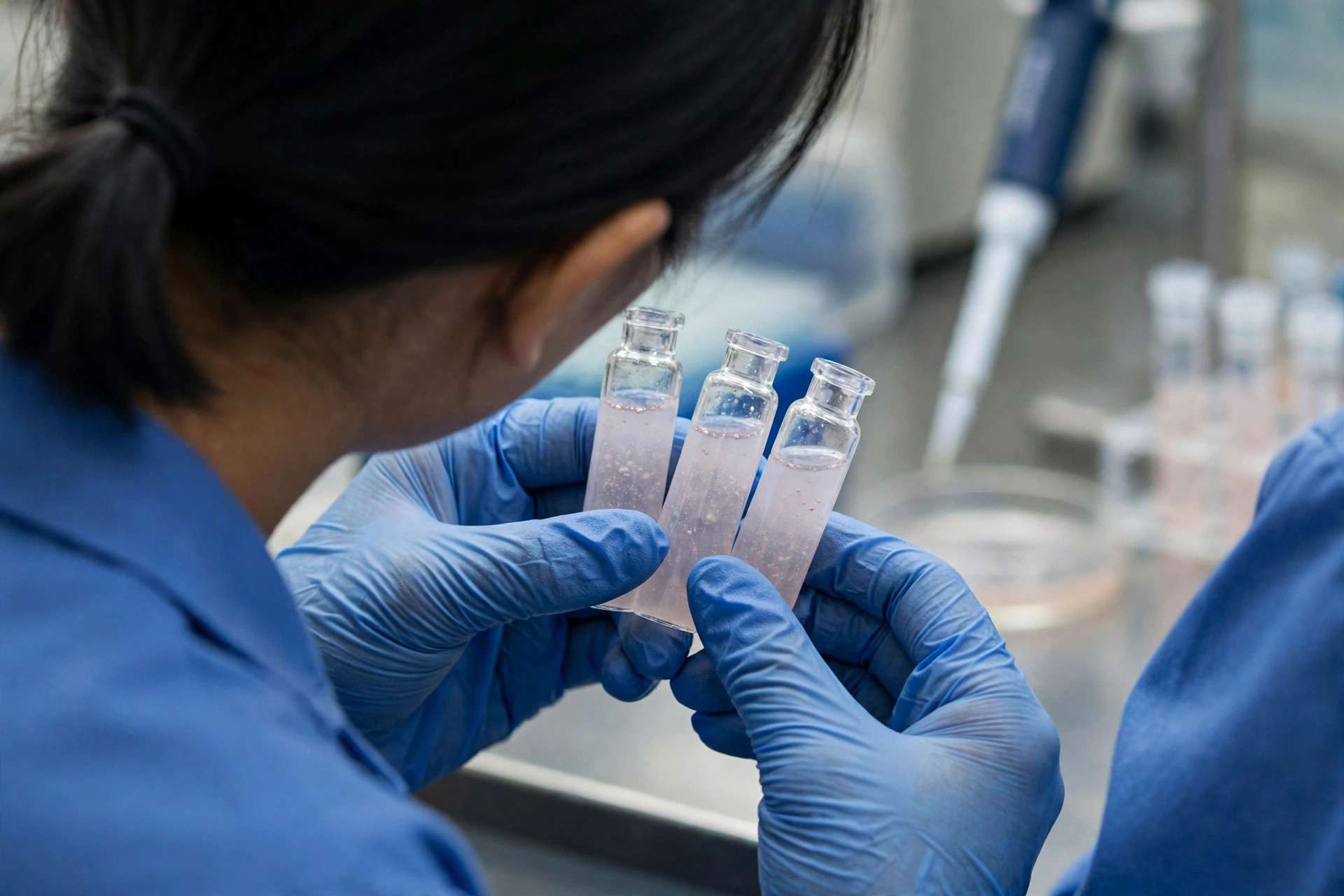
Exosomes are small extracellular vesicles released by cells. The ZENEXO certificate our clinic reviewed describes 1000 billion particles per 5 ml, derived from human Wharton’s Jelly MSCs. There is no viability line, because particles are not living cells. Comparing a cell count with a particle count is comparing two different measures.
How Each Product Is Characterised
Cell products are identified by CD markers on the cells themselves: positive markers such as CD73, CD90 and CD105 above 90 percent, negative markers below 1 to 2 percent, plus differentiation tests and a normal karyotype.
Exosome products are characterised by particle size and vesicle markers. The certificate we reviewed records particle size of 30 to 200 nm by nanoparticle tracking analysis, positive markers CD63, CD81 and CD9 present, and the negative marker GRP94 absent. Size and markers together show the particles match the expected profile.

Safety Testing for Each Type
Both product types require sterility, mycoplasma and endotoxin testing. The exosome certificate records sterility negative over 14 days, bacterial endotoxin below 0.25 EU per ml, and mycoplasma below 100 copies by real time PCR. Its parent MSCs were also checked, and the donor tissue was screened for hepatitis and HIV viruses, all not detected.
Cell product certificates record their own limits, for example endotoxin at or below 25 EU per ml for the cell preparations we reviewed. Always read the limit printed for the exact product in front of you.
Why They Are Not Interchangeable
Because the products are different, the evidence for one does not automatically apply to the other. A study of living MSCs does not prove an effect for an exosome preparation, and particle numbers cannot be converted into cell numbers.
Regulatory status can also differ by product and use. In Malaysia, cell and gene therapy products sit under the NPRA framework. Ask the clinic which product is actually proposed for you, why, and what evidence and status apply to that product specifically.
Questions to Ask at Any Clinic
Ask for the product name and type in writing. Ask whether it contains living cells or only vesicles. Ask for the batch certificate, and check that the measures on it match the product type: count and viability for cells, particle count, size and vesicle markers for exosomes.
At Medi Clinic, assessment comes first. Only after a doctor reviews your diagnosis do we discuss whether a cell product, an exosome product, or neither, belongs in your plan.
How to Read Two Certificates Side by Side
Place a cell product certificate and an exosome certificate next to each other and the difference becomes visual. The cell certificate leads with a cell count, a viability percentage and a passage number, followed by marker results measured on the cells themselves. The exosome certificate leads with a particle count per volume, a particle size range in nanometres, and vesicle markers such as CD63, CD81 and CD9.
Both documents should still share the safety backbone: sterility testing, mycoplasma testing and endotoxin limits, each with a stated method or limit and a passing result. The exosome certificate we reviewed also records donor screening and the checks performed on its parent MSCs, because the quality of the source cells shapes the vesicles they release.
If a document mixes the two vocabularies, quoting a particle count for a product sold as living cells, or a viability figure for a vesicle product, slow down and ask the clinic to explain. Confused paperwork is a reason to pause, whatever the explanation turns out to be.
Frequently Asked Questions
Are exosomes alive?
No. Exosomes are particles released by cells. They are not living cells, which is why exosome certificates record particle counts and sizes rather than cell viability.
Is a bigger particle count better than a cell count?
The numbers measure different things and cannot be compared directly. Judge each product by its own certificate, its characterisation and the evidence for its proposed use.
Can exosomes become stem cells in my body?
No. Exosomes do not become cells. Claims that blur exosomes and stem cells together should prompt you to ask for the exact product name and its batch certificate.
Which one is right for me?
That depends on your diagnosis and goals, and often the honest answer is neither until standard care has been properly considered. A doctor assessment decides, not a product menu.
How do I verify an exosome product?
Check particle count per volume, particle size range, CD63, CD81 and CD9 markers, sterility, endotoxin and mycoplasma results, and donor screening on the batch certificate.
Discuss Your Options With Our Doctor
Bring your questions and your records. Our doctors will assess your condition first, verify any product properly, and tell you honestly whether a cell based option belongs in your plan at all.
Content reviewed by Dr Michael Loh Wei Chieh (MBBS), Medical Director and LCP-certified Aesthetic Physician.