Doctor-Supervised Chemical Peel Treatment in JB

Doctor-Supervised Chemical Peel Treatment in Johor Bahru

A chemical peel applies a verified chemical formulation to create controlled injury at a selected skin depth. A professionally selected superficial peel may improve certain acne, texture, or pigmentation concerns, but chemical burns, infection, pigment changes, and scarring are possible, especially when the product or depth is unsuitable. The appropriate peel is defined by the product, skin, and treatment depth not by acid strength alone.

At Medi Clinic in Johor Bahru, our chemical peel treatment involves a doctor-supervised assessment to verify the formulation, evaluate pigmentation risks, and select the correct depth for your specific concern. We prioritise evidence-based medical chemical peels over aggressive, unverified procedures. Patients travelling from Singapore, Iskandar Puteri, and Taman Molek trust our transparent approach, knowing that we strictly adhere to Malaysian product verification standards and prioritise skin-barrier safety.
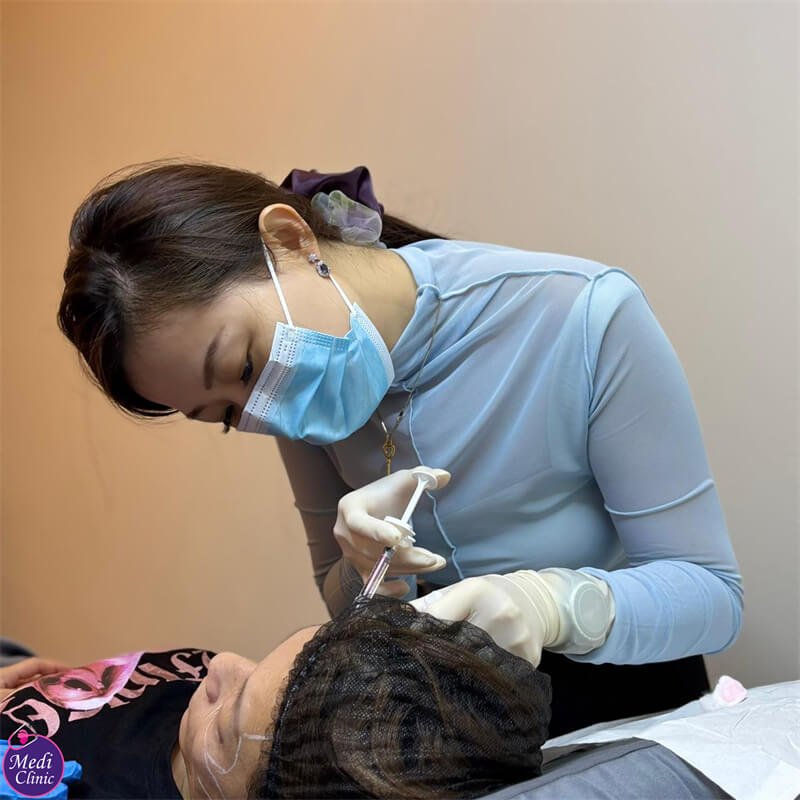
Doctor assessing skin before a chemical peel in Johor Bahru JB SG

How Chemical Peeling Works

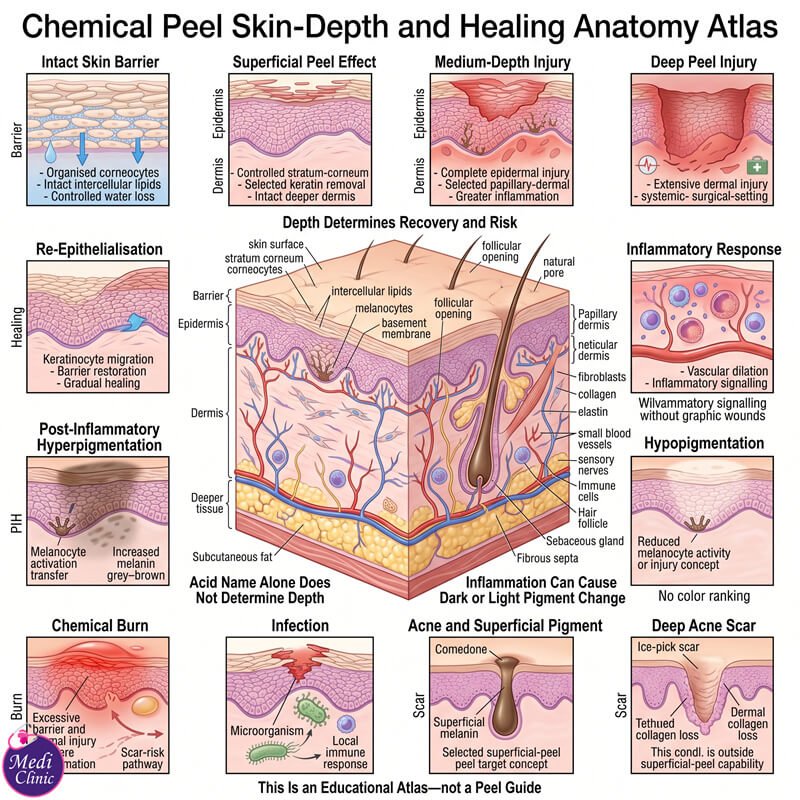
Chemical peels are categorized by depth. A superficial peel mainly affects the epidermis, using selected alpha-hydroxy acids (AHAs like glycolic, lactic, or mandelic acid) or beta-hydroxy acids (BHAs like salicylic acid) to address selected acne, rough texture, or superficial pigmentation. A medium-depth peel creates injury extending into selected dermal levels, carrying greater risks for swelling, blistering, and pigmentation changes. A deep peel involves extensive controlled chemical injury, often using phenol, which requires a surgical setting, anaesthesia, and carries systemic risks this is not an ordinary medical-aesthetic clinic facial.

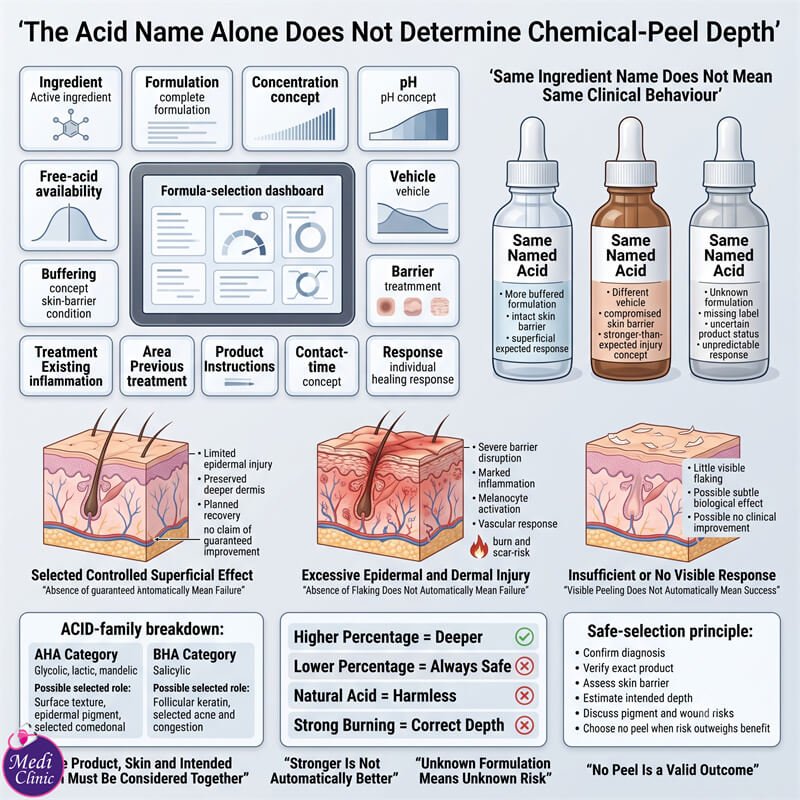
The acid name alone does not determine how deeply a peel will act. Peel depth is influenced by the ingredient concentration, formulation, pH, free-acid availability, contact time, and your skin’s barrier condition. Stronger is not automatically better. For Asian skin tones, preventing excessive inflammation is a critical part of the result, as overly aggressive peeling can cause post-inflammatory hyperpigmentation (PIH).
Superficial, medium and deep peel comparison JB SG
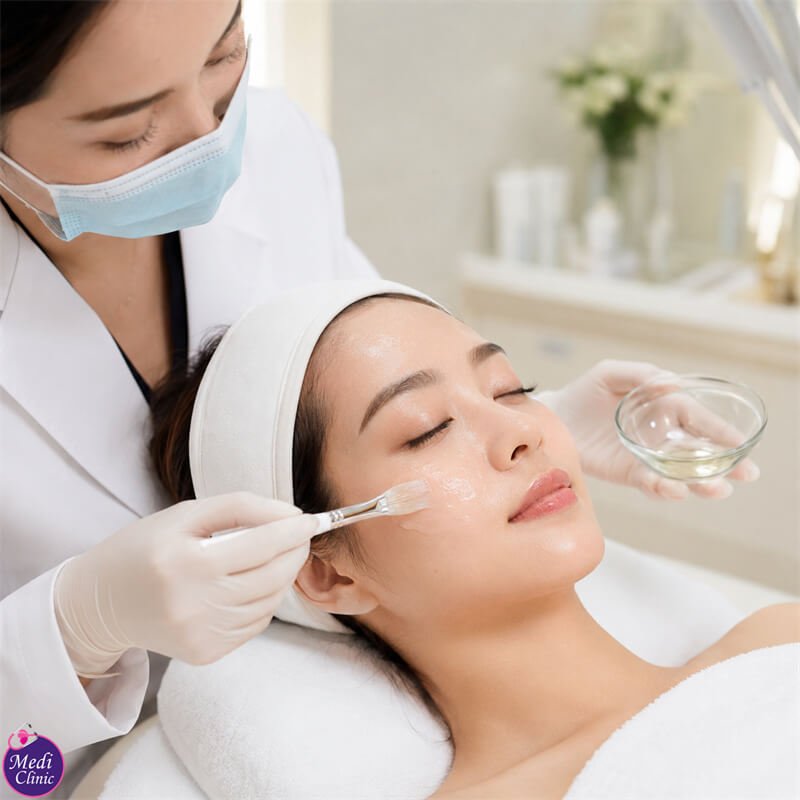
Chemical peel consultation at Medi Clinic JB SG

Evaluating Suitability for Chemical Peels

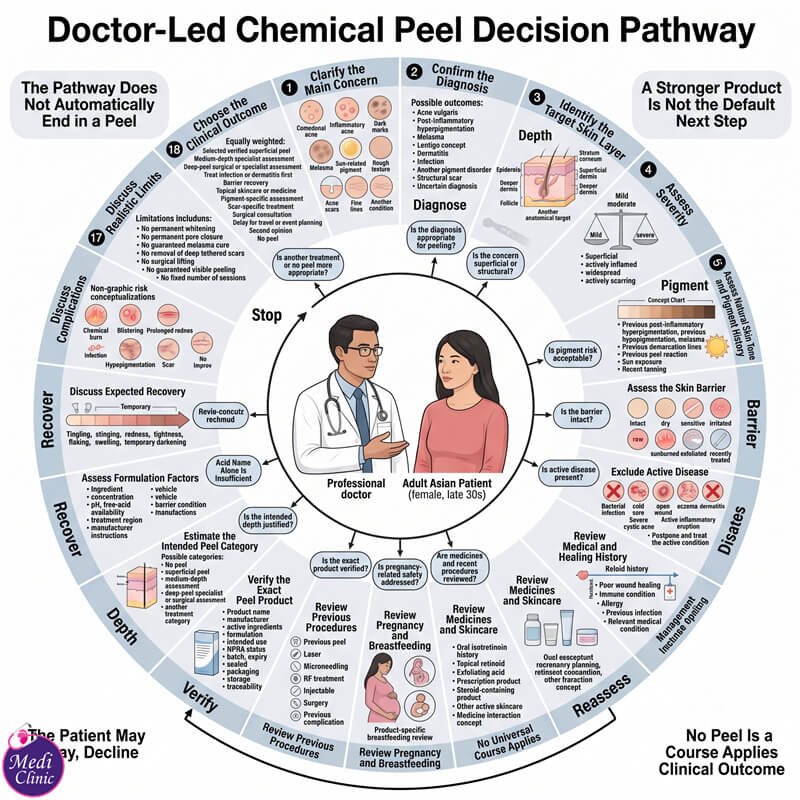
A facial peel treatment in JB is not a harmless skin-detox procedure; it requires a working diagnosis. We may consider a superficial chemical peel for selected comedonal acne, post-inflammatory marks, or superficial sun damage. However, chemical peels do not permanently whiten skin, permanently close pores, or guarantee a melasma cure. They cannot remove deep tethered acne scars or replace surgical lifting.

Treatment must be postponed over active bacterial infections, herpes cold sores, open wounds, active eczema, sunburn, or severe cystic acne. Acne severity should be controlled medically before aggressive scar or resurfacing procedures. We carefully review your medical history, including recent oral isotretinoin use, topical retinoids, keloid history, and pregnancy status (retinoid-containing peels are contraindicated during pregnancy). Furthermore, every exact peel product must be classified and verified according to its ingredients and intended use via Malaysian NPRA status. We do not use unlabelled clinic mixtures.

Understanding Peel Downtime & Aftercare

During the procedure, you may experience tingling, stinging, warmth, or burning. A chemical burn is a serious complication, and the absence of pain does not guarantee safety. Following a superficial peel, common temporary effects include redness, tightness, flaking, swelling, and temporary darkening. Severe blistering, prolonged redness, demarcation lines, or spreading infection require urgent clinical review.

Professional supervision does not make every peel risk-free, but unsupervised high-strength peeling at home can cause severe and permanent injury. Aftercare is vital. Follow our written clinic instructions, cleanse gently, keep healing skin moisturised, avoid picking or peeling skin manually, and use suitable sun protection. Do not combine the recovery phase with unapproved acids, scrubs, or retinoids. Darker skin tones require extra care to prevent post-inflammatory hyperpigmentation.
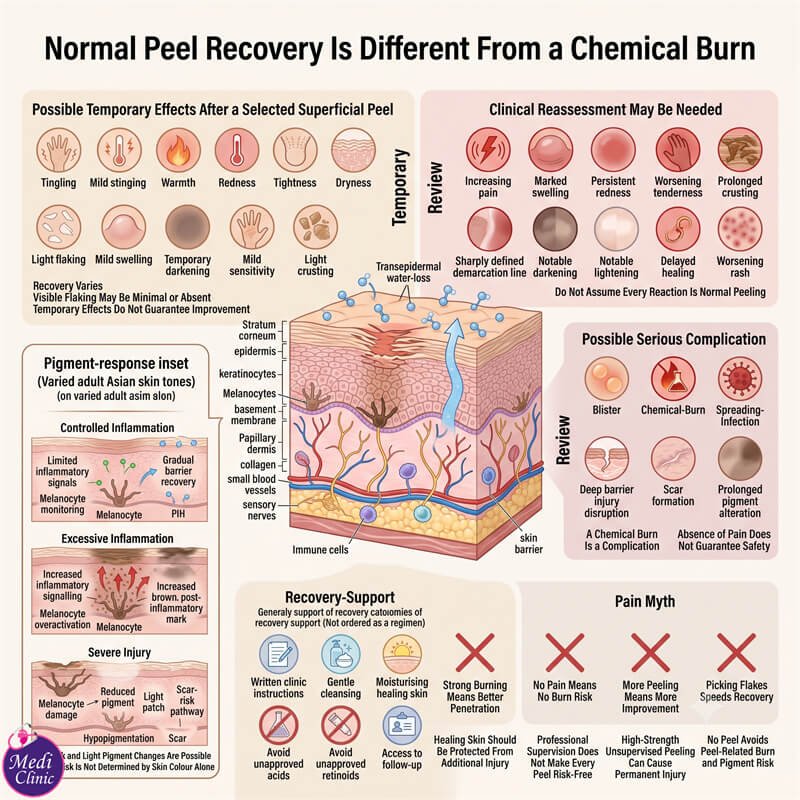
Doctor explaining chemical-burn and pigment risks JB SG
Chemical peel consultation for Singapore patients JB SG

What to Expect From Your Chemical Peel

Improvements from professional peeling are gradual. While some patients observe smoother-looking superficial texture or brighter-looking skin, results vary, and it is possible that no improvement occurs. Peeling does not equal clinical improvement the absence of visible skin flaking does not mean the treatment failed. Natural skin tone remains, pores remain, and ageing continues. We do not sell indefinite peel packages; there is no compulsory monthly course for every patient.

Patients travelling from Singapore to our Johor Bahru clinic should plan ahead. Please bring your current skincare products to the consultation and disclose any recent procedures or retinoid use. Understand the expected downtime before crossing the Causeway or Tuas Second Link, and avoid first-time peels immediately before an important event. We arrange appropriate follow-up care and provide clinical guidance tailored to your healing response.

Frequently Asked Questions About Chemical Peels

Here are answers to common questions about chemical peel safety, depths, and realistic expectations. This information helps you have an informed discussion with our doctor.

What is a chemical peel?

A chemical peel applies a verified chemical formulation to create controlled injury and remove or remodel selected skin layers.

What is the difference between superficial, medium and deep peels?

They affect different skin depths and have different recovery, wound-care and complication risks. A deep peel is not an ordinary facial procedure.

Does a stronger acid produce a better result?

No. Peel depth and safety depend on the complete formulation, pH, application, treatment area and skin condition not concentration alone.

Can chemical peels treat acne?

Selected superficial peels may help comedonal or mild inflammatory acne, but painful nodules, cysts and scarring acne require broader medical treatment.

Can a chemical peel remove acne scars?

It may improve very superficial texture or post-acne marks, but deep ice-pick, rolling, tethered or raised scars usually need another treatment plan.

Can chemical peels permanently cure melasma?

No. Melasma is chronic and may recur. Aggressive peeling can also worsen pigmentation.

What are the possible side effects?

Possible effects include stinging, redness, swelling, peeling, crusting, burns, infection, prolonged redness, dark or light pigment changes and scarring.

Are chemical peels safe for Asian skin?

Selected peels may be suitable, but Asian and pigmentation-prone skin requires conservative depth selection and careful aftercare to avoid post-inflammatory hyperpigmentation.

Are high-strength home chemical peels safe?

High-strength acids can cause severe chemical burns, wounds, infection and permanent scarring when used without suitable professional supervision.

How many chemical peel sessions are needed?

There is no universal course. The number depends on the diagnosis, formulation, peel depth, response, side effects and patient preference.
Peel Depth, Full Formulation, Pigment Risk, Wound Care & Product Verification

Chemical Peel Depth Is Defined by the Whole Formulation — Not Acid Percentage Alone

A chemical peel creates controlled injury at a selected skin depth. Superficial, medium and deep peels have very different recovery and complication profiles. The result depends on the ingredient, concentration, formulation, pH, free-acid availability, contact time, application, treatment area and barrier condition. A doctor should diagnose the concern, screen infection and pigment risk, verify the exact product and select the minimum effective depth.

Chemical-peel guide

Select a peel-planning pathway

Then review four checkpoints: superficial, medium and deep peel anatomy; full formulation and true depth drivers; contraindications, PIH and NPRA verification; and burn warning signs, wound care, realistic outcomes and Singapore follow-up.

Chemical peel depth, formulation, pigment-risk, burn and aftercare review Interactive comparison between doctor-assessed verified minimum-effective peeling and unsupervised high-strength acid use. DIAGNOSIS → FORMULATION/pH/FREE ACID/CONTACT TIME → DEPTH → PIH/BURN RISK → WOUND CARE/FOLLOW-UP Superficial Medium Deep Epidermis Papillary dermis Reticular dermis Deeper tissue AHA/BHA Selected dermal Phenol/deep Depth ≠ acid name or percentage alone Concentration • formulation • pH • free acid • time • barrier • technique Deep phenol peeling is not an ordinary medical-aesthetic facial Superficial / medium / deep Epidermal vs dermal injury • different recovery/systemic risk Full formulation + depth drivers Ingredient/concentration/pH/free acid/time/barrier/application Suitability + PIH/NPRA Infection/herpes/barrier/isotretinoin/pregnancy/keloid • Asian-skin PIH Burn signs + wound care Blister/demarcation/infection • moisturise/no picking/sun care Verified minimum-effective peel Diagnosis • product/NPRA • depth drivers • PIH screen • written wound care High-strength shortcut Highest % + longest contact + visible burn = strongest result Run Peel Safety Review

Pigmentation Treatment Gallery

Pigmentation peel assessment in Taman Molek JB SG
Chemical peel consultation near Iskandar Puteri JB SG
Skin-peel planning near Eco Botanic JB SG
Chemical peel consultation near Eko Galleria JB SG

Find Out if Medical Pigmentation Treatment is for You

Our doctor at Medi Clinic Johor Bahru can accurately assess your skin condition and pigmentation type. We will let you know if a chemical peel, laser therapy, or medical creams are a suitable option for you. We provide a thorough consultation, discuss realistic timelines, and ensure skin-barrier safety remains the top priority.
Medi Clinic JB — Chemical Peel Smart Guide

How Well Do You Understand Chemical Peels?

Understand Treatment Safety in 60 seconds

Chemical Peel Suitability Quiz

Step 1 / 10
This quiz cannot confirm chemical-peel suitability. A doctor should assess the diagnosis, skin tone, pigment history, active skin disease, medicines, previous procedures, exact formulation, expected peel depth, recovery and alternatives.
💬 Book Chemical Peel Consultation

Understanding the Treatment Timeline

At Medi Clinic, we believe in clear communication. Healing safely takes time. We help patients from Johor Bahru and Singapore understand the skin recovery process. We set realistic goals and provide structured follow-up care to avoid rebound hyperpigmentation and scarring.
Days
Initial Redness & Controlled Peeling
Weeks
Skin Healing & Barrier Recovery
Months
Visible Improvement in Texture or Tone
Ongoing
Sun Protection & Optional Maintenance
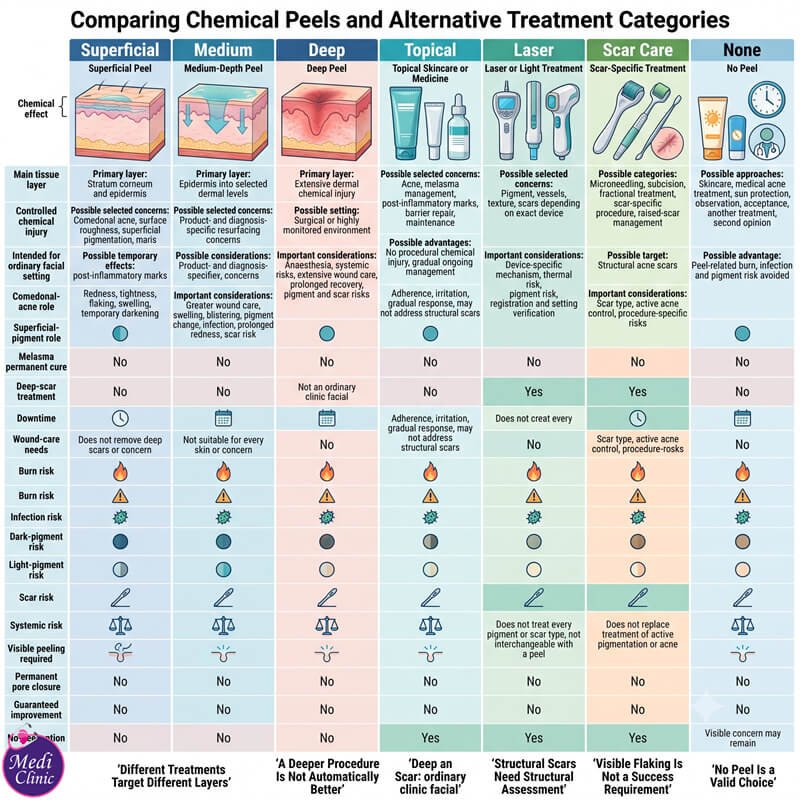
Compare Skin Treatment Approaches
Treatment Category Method Main Benefit & Limitation MEDICAL
SUPERFICIAL CHEMICAL PEEL Controlled chemical exfoliation mainly affecting the epidermis. Advantage: Selected acne, congestion, superficial pigmentation or rough texture. Limitation: Irritation, burns and pigment changes remain possible.
MEDIUM-DEPTH PEEL Controlled chemical injury extending into selected dermal levels. Advantage: Selected deeper pigment, wrinkle or scar concerns. Limitation: Greater swelling, blistering, wound care, pigment and scar risks.
DEEP PEEL Extensive controlled chemical injury in a surgical setting. Advantage: Selected severe photoageing concerns under specialist management. Limitation: Major recovery, systemic monitoring and permanent pigment or scar risks.
TOPICAL SKINCARE Lower-intensity products used gradually over time. Advantage: Acne, pigment control, texture and maintenance. Limitation: Gradual results and possible irritation.
MICRONEEDLING Mechanical needles create controlled punctures. Advantage: Selected atrophic scars and texture concerns. Limitation: Bleeding, infection, pigment and scar risks.
LASER TREATMENT Light energy targets selected skin structures. Advantage: Product- and wavelength-specific pigment, scar or resurfacing concerns. Limitation: Heat, downtime and pigment risk vary by device.
MEDICAL FACIAL Cleansing and hydration without controlled peel wounds. Advantage: Gentle maintenance. Limitation: Does not provide significant structural skin remodeling.
NO PROCEDURE Skincare, observation or medical management without peeling. Advantage: Avoiding procedure risk or stabilising the skin first. Limitation: The visible concern may remain.
SUPERFICIAL CHEMICAL PEEL
Method:
Controlled chemical exfoliation mainly affecting the epidermis.
Main Benefit & Limitation:
Advantage: Selected acne, congestion, superficial pigmentation or rough texture. Limitation: Irritation, burns and pigment changes remain possible.
MEDIUM-DEPTH PEEL
Method:
Controlled chemical injury extending into selected dermal levels.
Main Benefit & Limitation:
Advantage: Selected deeper pigment, wrinkle or scar concerns. Limitation: Greater swelling, blistering, wound care, pigment and scar risks.
DEEP PEEL
Method:
Extensive controlled chemical injury in a surgical setting.
Main Benefit & Limitation:
Advantage: Selected severe photoageing concerns under specialist management. Limitation: Major recovery, systemic monitoring and permanent pigment or scar risks.
TOPICAL SKINCARE
Method:
Lower-intensity products used gradually over time.
Main Benefit & Limitation:
Advantage: Acne, pigment control, texture and maintenance. Limitation: Gradual results and possible irritation.
MICRONEEDLING
Method:
Mechanical needles create controlled punctures.
Main Benefit & Limitation:
Advantage: Selected atrophic scars and texture concerns. Limitation: Bleeding, infection, pigment and scar risks.
LASER TREATMENT
Method:
Light energy targets selected skin structures.
Main Benefit & Limitation:
Advantage: Product- and wavelength-specific pigment, scar or resurfacing concerns. Limitation: Heat, downtime and pigment risk vary by device.
MEDICAL FACIAL
Method:
Cleansing and hydration without controlled peel wounds.
Main Benefit & Limitation:
Advantage: Gentle maintenance. Limitation: Does not provide significant structural skin remodeling.
NO PROCEDURE
Method:
Skincare, observation or medical management without peeling.
Main Benefit & Limitation:
Advantage: Avoiding procedure risk or stabilising the skin first. Limitation: The visible concern may remain.

Discuss Chemical Peeling with Our Doctor


Book a doctor-supervised chemical-peel consultation at Medi Clinic in Johor Bahru to identify whether your concern involves acne, pigmentation, melasma, texture, scarring or another condition and whether a verified superficial peel or an alternative treatment is appropriate. We provide transparent assessments regarding product formulation, depth, and downtime for patients from Tebrau, Setia Tropika, Kempas, and Singapore. Our clinic is committed to safe, responsible aesthetic care.

All Services

Explore our other aesthetic services.

Medi Clinic Johor Bahru doctor-led chemical peel consultation

30+

Years of experience

4K+

Happy customers

15K+

Success Story

70+

Services Provided

Aesthetic Clinic in Taman Molek, Johor Bahru

Book a doctor-led skin assessment to discuss your skin concerns, aesthetic goals and treatment suitability.

Explore aesthetic treatments available at our Taman Molek clinic.

Aesthetic Clinic in Eco Botani, Iskandar Puteri

Book a doctor-led skin assessment to discuss your skin concerns, aesthetic goals and treatment suitability.

Explore aesthetic treatments available at our Eco Botani clinic.