Aesthetic Surgery in Japan for Malaysian & Singapore Patients
Choose the surgeon, the exact operation, and the complete care pathway not simply the destination, clinic brand, or advertised technique name. Before travelling, it is essential to understand whether surgery is necessary, how to verify a Japanese surgeon’s qualifications, what risks are involved, and how to manage your recovery. Many patients from Singapore and across Malaysia choose our Johor Bahru clinic for an independent, doctor-led educational consultation before committing to cosmetic surgery in Japan.

Facial Rejuvenation is Not One Procedure
Furthermore, non-surgical treatments like fillers or thread lifts provide different, more limited structural changes. The correct choice depends on the anatomical cause of your concern and the amount of change you are willing to accept. Combining multiple operations (like a facelift with a brow lift) may reduce separate trips to Japan, but it lengthens the operation, increases blood loss, extends anaesthetic exposure, and complicates recovery. More procedures do not automatically create a safer or better result.
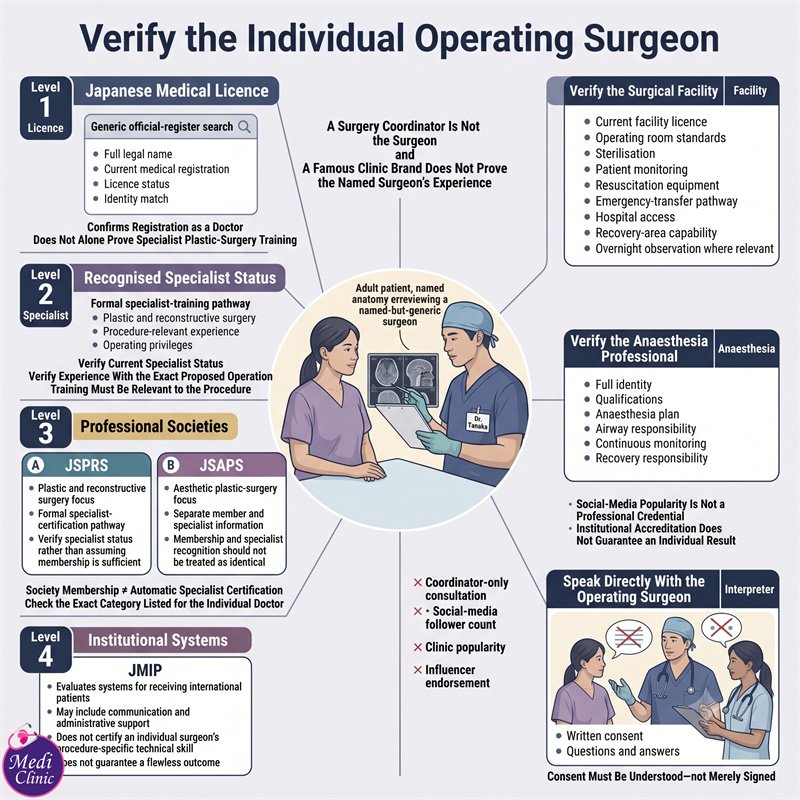

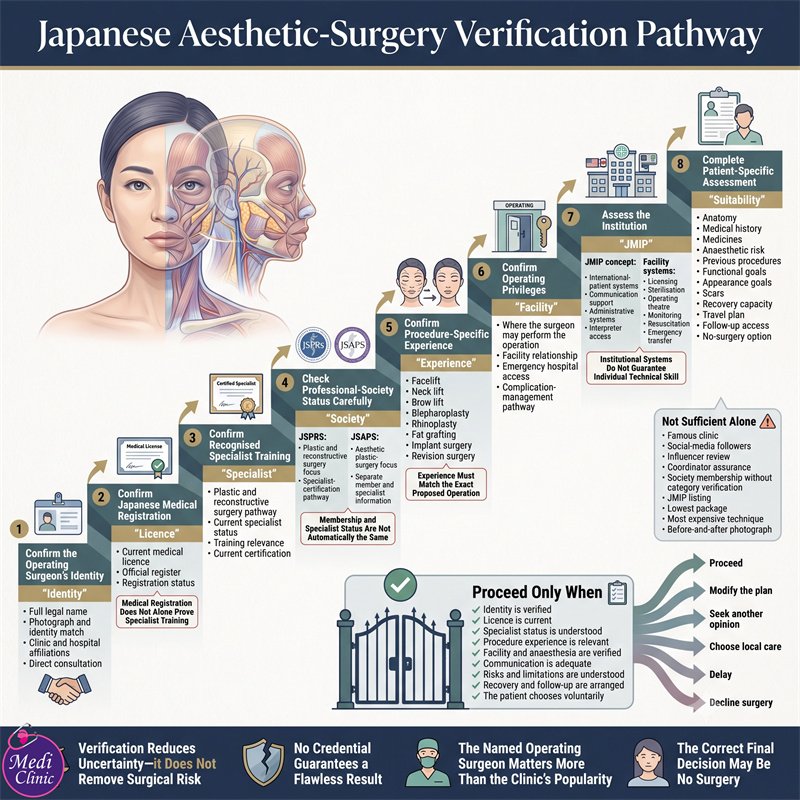
Verifying Your Japanese Surgeon & Facility
Organisations like the Japan Society of Plastic and Reconstructive Surgery (JSPRS) operate a formal specialist-certification pathway, while the Japan Society of Aesthetic Plastic Surgery (JSAPS) focuses on aesthetic procedures. Distinguish between ordinary society membership and recognized specialist status. Additionally, verify the operating facility. While Japan Medical Service Accreditation for International Patients (JMIP) evaluates a medical institution’s systems for receiving international patients, it does not certify an individual surgeon’s aesthetic skill or guarantee a flawless outcome. A surgery coordinator is not the surgeon, and you must communicate directly with the doctor performing your operation.
Understanding Risks, Travel & Complications
Recent surgery and extended immobility during travel can independently increase blood-clot risks, such as deep-vein thrombosis (DVT) and pulmonary embolism. You must receive a written plan covering the surgery date, postoperative reviews, and pre-flight clearance from the individual surgical team. Avoid non-changeable flights, as swelling or infection may worsen and travel may need to be postponed. Rapid swelling or severe pain requires urgent in-person assessment and cannot be managed via messaging alone.
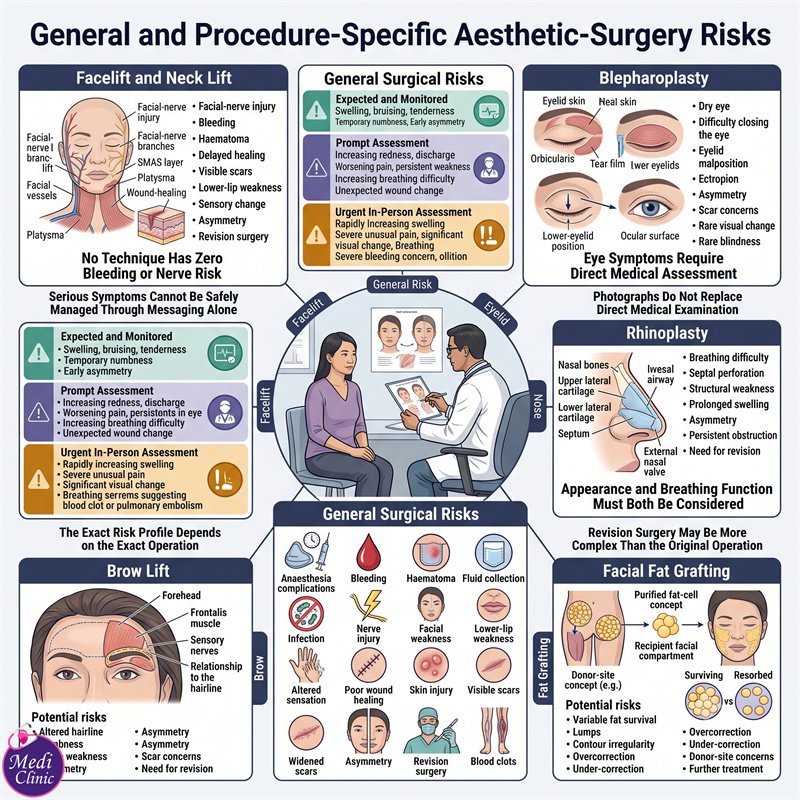
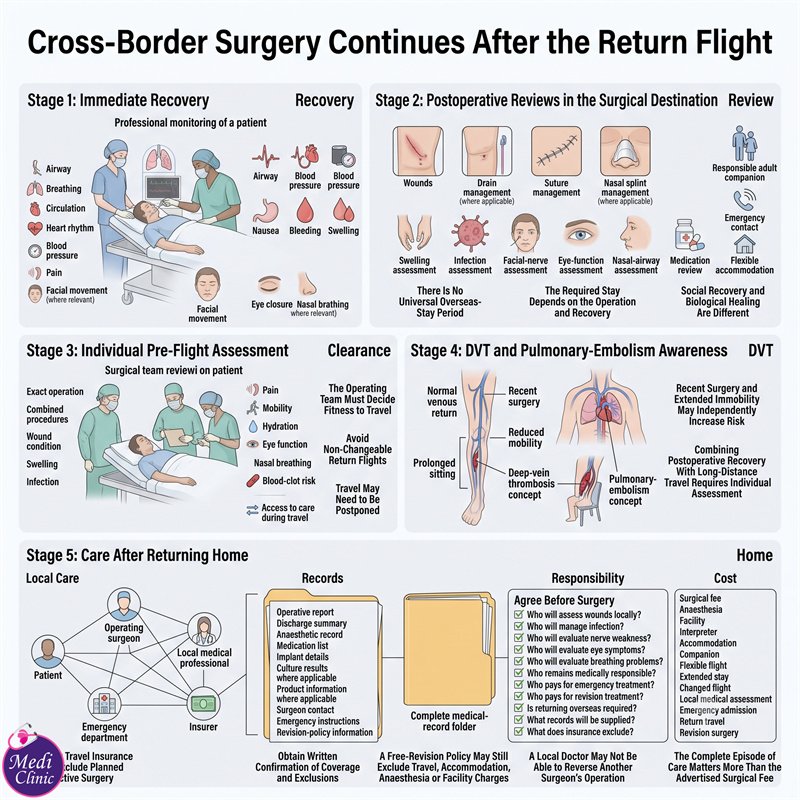
Postoperative Care in Malaysia & Singapore
Patients must obtain complete medical records including the operative report, implant details, culture results (where applicable), and discharge summary so your receiving medical team can understand your treatment safely. Compare the complete episode-of-care cost rather than only the advertised surgical fee. Be aware that standard travel insurance often completely excludes planned elective surgery and any related complications, extended hotel stays, or changed flights.
Frequently Asked Questions About Surgery in Japan
Is aesthetic surgery in Japan automatically safer?
How can I verify a Japanese plastic surgeon?
What is the difference between JSPRS and JSAPS?
Does JMIP accreditation guarantee a good result?
What aesthetic surgeries are available in Japan?
How long should I remain in Japan after surgery?
When can I fly home after surgery?
Who manages complications after I return home?
Does travel insurance cover cosmetic surgery?
Choose the Exact Operation and Verified Surgical Team — Not Japan, a Clinic Brand or a Technique Name
Aesthetic surgery in Japan may include facelift, eyelid surgery, rhinoplasty, facial fat grafting, implants or revision surgery, but each operation has different anatomical goals, scars, risks and recovery needs. A responsible plan verifies the individual surgeon, formal specialist status, facility and anaesthesia system, understands JSPRS, JSAPS and JMIP correctly, and establishes postoperative reviews, flight clearance, complete records and local complication care before travelling.
Select a planning pathway
Then review the four checkpoints: operation matching and combined-procedure burden; Japanese surgeon, JSPRS, JSAPS and JMIP verification; general and procedure-specific complications; and recovery, flight clearance, complete records, insurance exclusions and responsibility after returning to Malaysia or Singapore.
Medical Travel Planning Checklist
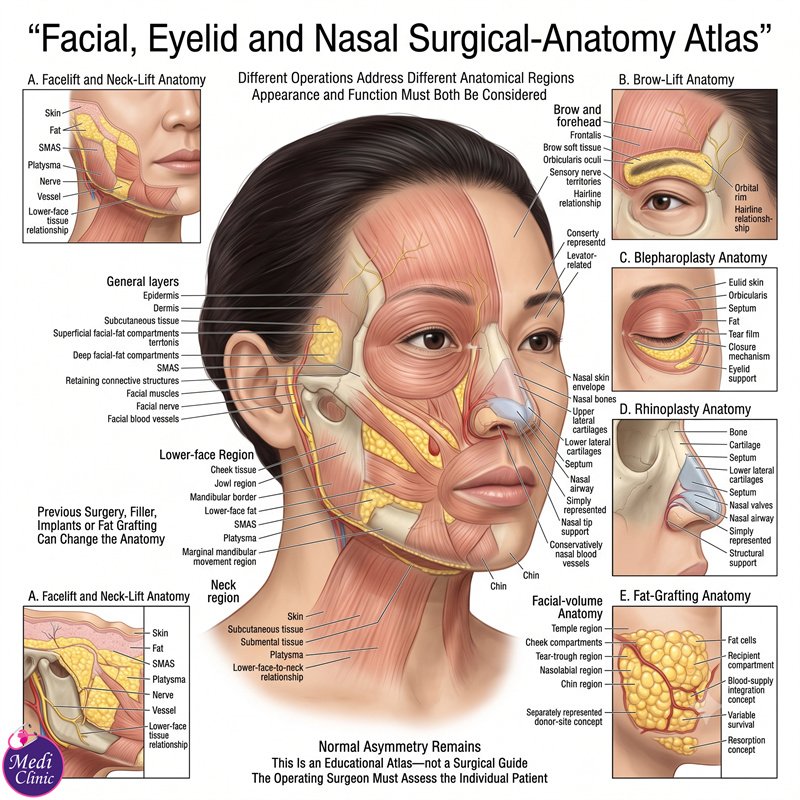


Find Out if You Are Medically Ready to Travel
Are You Prepared to Consider Aesthetic Surgery in Japan?
Medical Travel Knowledge Check
Understanding the Recovery Timeline
| Surgery Type | Focus Area & Scars | Potential Risks MEDICAL |
|---|---|---|
| Facelift (Rhytidectomy) | Targets lower-face and selected neck laxity. Scars typically around the hairline and ears. | Facial-nerve injury, bleeding, haematoma and delayed wound healing. |
| Eyelid Surgery (Blepharoplasty) | Addresses selected upper- or lower-eyelid concerns. Eyelid scars. | Dry-eye symptoms, eyelid malposition (ectropion) and visual risks. |
| Rhinoplasty | Alters selected nasal shape or functional structure. Internal or external surgical access. | Breathing difficulty, septal perforation, structural weakness and revision risks. |
| Brow Lift | Manages selected brow and forehead descent. Scalp or hairline-related scars. | Altered hairline, numbness, nerve weakness and asymmetry. |
| Facial Fat Grafting | Addresses selected facial-volume concerns. Involves donor-site and facial treatment. | Variable fat survival, lumps, contour irregularity and overcorrection risks. |
Discuss Medical Travel Planning with Our Doctor
Book a doctor-led consultation at Medi Clinic in Johor Bahru to understand whether facial rejuvenation surgery is appropriate, compare surgical and non-surgical options, and prepare a safer medical-travel plan before committing to treatment overseas. We respect your decision if you choose no surgery, and we focus on objective education rather than rushing you into a surgical package.
Explore our other aesthetic services.
30+
Years of experience
4K+
Happy customers
15K+
Assessments Performed
70+
Services Provided


