MEDI CLINIC AESTHETIC JOHOR

Laser Safety in JB: How to Check a Device Is MDA-Registered
Laser Safety in JB: How to Check a Device Is MDA-Registered

A laser treatment is only as safe as three things: the right diagnosis, the right device for that diagnosis, and a device that is registered in Malaysia for its intended purpose. A laser is a medical device, not a beauty gadget — and in Malaysia, a medical laser must be registered with the Medical Device Authority (MDA) and listed on the Malaysian Medical Device Register (MDAR) for the purpose it is used for. Foreign clearance from another country is not a substitute for Malaysian registration, and a familiar brand name is not proof of registration either. Before you book, ask the clinic to name the exact device — trade name, model, wavelength, handpiece and manufacturer — and to confirm its current MDA registration and MDAR status. If the clinic cannot name the device, or the answers are vague, that is a reason to pause. Learn more about our Laser Therapy Treatment in JB.
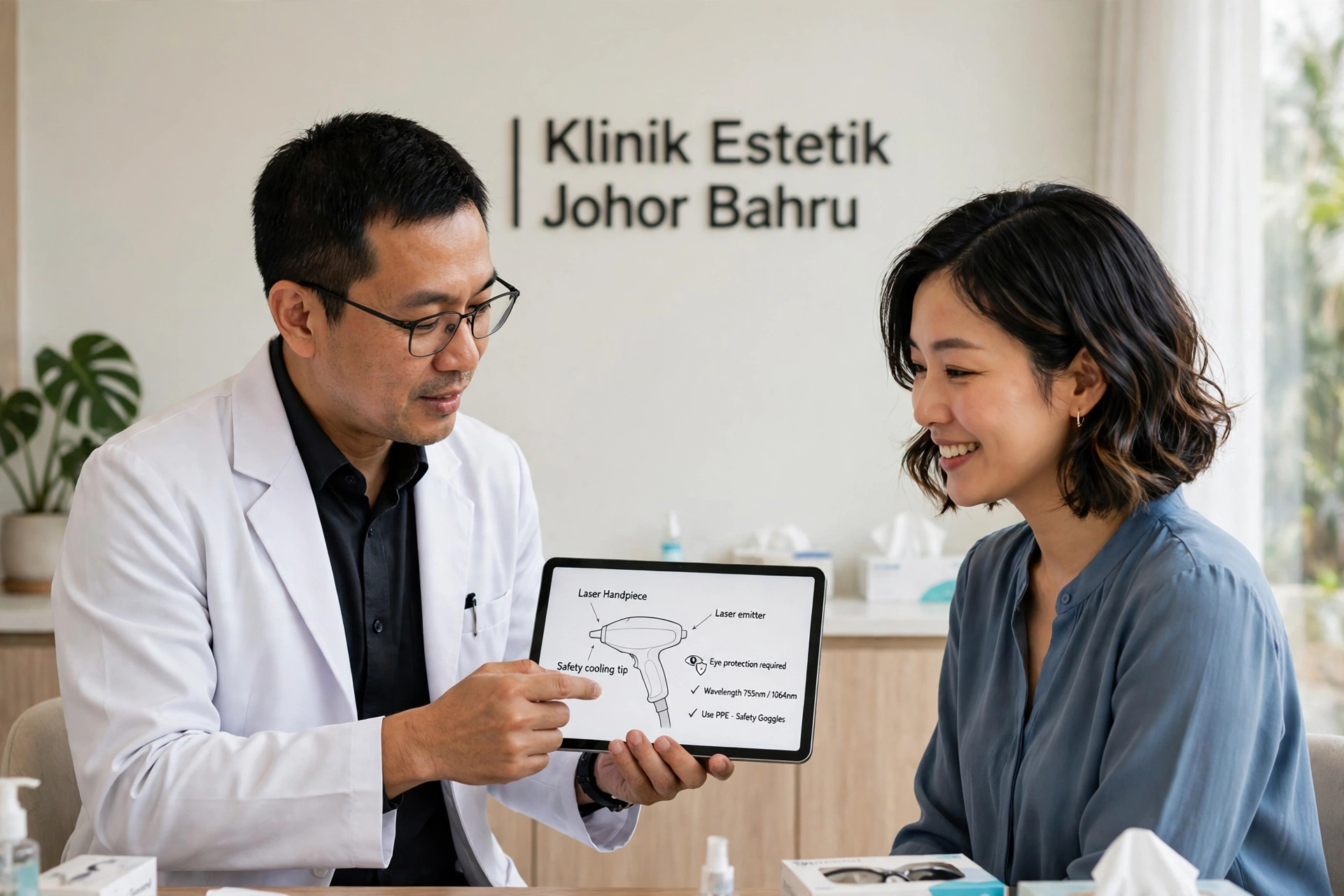
Doctor-led laser safety consultation in Johor Bahru with an East Asian woman in her mid-30s

What Is a Laser?

Aesthetic laser is a technology category, not one universal skin treatment. A laser delivers organised light at one principal wavelength, and the light is preferentially absorbed by a target chromophore such as melanin, haemoglobin or water, while limiting injury to the surrounding tissue. This is selective photothermolysis: the effect depends on the wavelength, the pulse duration, the spot size, the skin tone and the technique of the operator. But selectivity is not absolute — normal epidermal melanin may also absorb energy, and excessive or unsuitable treatment can cause burns. Which laser fits depends on the diagnosis and the wavelength, not on the word laser alone. Depending on the exact diagnosis, a Q-switched or picosecond laser may be recommended for selected benign pigment and tattoos, a vascular laser for redness, and an ablative or non-ablative fractional laser for selected scars and texture. A Q-switched Nd:YAG laser, whose wavelength most commonly described for pigment work is 1064 nm, is one commonly described option. Picosecond describes a pulse-duration category, not a universal treatment identical across all devices. Fractional delivery means treating microscopic columns of tissue, and it may use several different wavelengths such as CO2 or erbium depending on the goal. It is important to know what a laser is — and what it is not. It is not IPL or LED: IPL uses broad-spectrum filtered light and LED uses lower-intensity non-laser light — they are separate technologies with separate indications and risks, and they should not be mislabelled as lasers. A laser also cannot replace lost facial volume, stop natural ageing, or guarantee a permanent melasma cure. Melasma is a chronic condition that may relapse, and it may even worsen with unsuitable laser treatment. What Is MDA Registration — and What Is MDAR? In Malaysia, medical devices are regulated by the Medical Device Authority (MDA), and registered devices are listed on the Malaysian Medical Device Register (MDAR). Registration means the device has been assessed for the specific purpose the manufacturer states it is intended for — the intended purpose. A laser registered for one purpose is not automatically registered for another, and a device registered years ago should still be checked for its current status, because registrations can change. That is why device verification means checking the exact trade name, model, wavelength, handpiece, manufacturer, MDA registration, MDAR status, intended purpose and authorised supplier — not just the brand name on the box. A clinic should be able to give you these details in plain language and explain how you can check them. Foreign clearance — for example, clearance granted in another country — is not a substitute for Malaysian registration, and foreign indications should not be transferred to Malaysia. If a device is described only by a foreign approval, or by a certificate you cannot verify, that is a reason to ask more questions before proceeding. No specific registration number is named in this article, because no registration number for the devices of the clinic has been verified for publication. The clinic must confirm the exact device and its current registration at consultation. Comparison — MDA-Registered Laser vs Unverified Laser vs Pico Laser vs Q-Switched Laser vs IPL vs LED vs No Procedure MDA-Registered Laser is a doctor-planned laser treatment using a device registered in Malaysia for its authorised intended purpose, after diagnosis. Laser energy targets a chromophore gradually, with recovery time between sessions. It is commonly described for selected pigment, vessels, scars or hair, after diagnosis. It needs a course of sessions decided at consultation, it does not permanently cure melasma, and it does not suit every concern. Unverified Laser is a laser device that cannot be identified by name, model and current Malaysian registration. Energy is delivered without verified registration, wavelength or intended purpose — so safety, settings and intended purpose are all unknown. It is not a treatment to choose. If a device cannot be named and checked, pause and check first. Pico Laser uses picosecond pulses — very short pulse durations — for selected benign pigment and tattoos. Picosecond describes a pulse-duration category, not one universal treatment identical across all devices. It is a different way of delivering laser energy, not a stronger version of a standard pigment laser, and which one fits depends on the diagnosis. Q-Switched Laser is a doctor-planned Q-switched laser approach, often low-energy repeated passes over several sessions. A Q-switched Nd:YAG laser is one commonly described option for selected benign pigment and tattoos. It targets melanin gradually, with recovery time between sessions. It needs a course of sessions decided at consultation, it does not permanently cure melasma, and it does not clear every type of pigment. IPL is intense pulsed light — broad-spectrum filtered light, not a laser. Broad-spectrum light targets pigment and redness, and it is commonly described for selected pigment and redness after diagnosis. It has separate indications and risks from lasers, and it does not remove every type of pigment. LED (photobiomodulation) uses lower-intensity non-laser light and is not a laser. It has separate indications and risks, and it does not target pigment the way a laser plan is described to. In short: a registered laser is verified for a stated purpose and chosen by diagnosis; an unverified laser cannot be checked and should not be chosen; a Pico laser uses very short pulses; a Q-switched laser targets melanin gradually; IPL and LED are non-laser light technologies with separate indications and risks. They are different tools for different jobs, and sometimes more than one is discussed as part of a plan — but that should be decided at consultation, not from a brochure.
Mechanism atlas showing laser energy targeting melanin through selective photothermolysis
Assessment atlas for the six laser device verification steps in JB

How to Check a Device Is MDA-Registered

Step 1 — Ask for the exact device in writing. Before booking, ask: which exact laser device will be used on me? You want the trade name, the model, the wavelength, the handpiece and the manufacturer — not just a Pico laser or a Q-switched laser. A genuine device has a name and a model number; a vague answer is a warning sign. Step 2 — Ask for the registration details. Ask whether the device is registered with the MDA in Malaysia, what its current MDAR status is, and how you can check that status yourself. A clinic that verifies its devices should be able to explain the check in plain language. Step 3 — Check the intended purpose matches your concern. A device is registered for specific intended purposes. Ask what the device is registered to treat, and whether that matches your diagnosis — pigment, vessels, scars, hair or texture. If the intended purpose does not match your concern, the device is not the right one for you, whatever its brand name. Step 4 — Check the authorised supplier. Ask who the authorised supplier of the device is in Malaysia. Genuine devices come through authorised channels, with service and parts support; a device with no clear authorised supplier is harder to verify and harder to trust. Step 5 — Check the handpiece and the settings. The handpiece is the part that delivers the energy to your skin, and the settings — wavelength, energy and pulse duration — must suit your skin tone and your diagnosis. Ask which handpiece will be used and why those settings were chosen for you. Step 6 — Ask who operates it and how your eyes will be protected. Laser treatment should be doctor-supervised, with an assessment first. Ask who will operate the device, and what eye protection will be used — protection must be appropriate for the exact wavelength and correctly fitted. Ordinary sunglasses, or simply closing your eyes, do not automatically provide suitable protection. Keep the answers. A clinic that is confident about its devices will not mind you writing the details down, and having them in writing makes it easy to check them later or to show another doctor. A good consultation should leave you able to answer these questions for yourself: Which exact laser device and wavelength will be used on me, and is it registered in Malaysia for the purpose I need? What is its current MDAR status, and how can I check it? Who is the authorised supplier? Which handpiece will be used, and why were these settings chosen for my skin tone? Who will operate the device, and is the treatment doctor-supervised? What eye protection will be used, and is it matched to the exact wavelength? What is my diagnosis — and is it pigment, vessels, scars, hair or texture? What are the risks for me, and is there anything in my history — recent sun exposure or tanning, keloid tendency, photosensitising medicines, active skin disease, previous pigment reactions, or isotretinoin use — that changes the plan? What sun protection and aftercare are needed, and what follow-up is included if pigment darkens after I return home? If a clinic cannot answer these plainly, keep looking. Some answers are warning signs, and they are worth taking seriously. The claim that all lasers are the same is not true — different targets such as pigment, vessels, scars and hair require completely different devices. A foreign approval offered as the only proof of registration is not enough, because foreign clearance is not a substitute for Malaysian registration. No eye protection, or ordinary sunglasses offered as protection, is a reason to stop — laser energy can severely injure the eye. Pressure to buy a package, pay for many sessions upfront, or sign up for an indefinite course is a warning sign: there is no compulsory monthly course for every patient, and maintenance is always optional. A first-time treatment offered immediately before an important event is a reason to wait, because redness, swelling or pigment change may occur. An undiagnosed suspicious pigmented lesion offered laser treatment to improve appearance is a reason to walk away — a lesion should be diagnosed before laser energy is applied, and the doctor may recommend another treatment, a biopsy, a referral, or even no procedure at all. And a treatment chosen from social-media photographs, without an in-person diagnosis, is not a plan — it is a guess.

Risks & Safety — Asian Skin, Sun and Eye Protection

No laser treatment is risk-free, and it helps to go in with your eyes open. Laser energy can cause pain, redness, swelling, blistering and temporary darkening. A burn is a serious complication. For Asian skin tones (Fitzpatrick types III–V), the risk needs special attention: normal epidermal melanin also absorbs laser energy, so excess epidermal melanin increases the risk of post-inflammatory hyperpigmentation, mottled colour loss (hypopigmentation), or permanent scarring if inappropriate wavelengths or settings are used. This risk is higher after tanning or previous pigment reactions. That is why the doctor reviews your skin tone, tanning, melasma, eczema and recent sun exposure before treatment, and why careful, conservative settings matter more than aggressive ones. Sun exposure matters before and after every laser session. The treated area should not be sunburnt or recently tanned, and strict sun protection is needed before and after each session. Avoid first-time treatments immediately before an important event, because redness, swelling or pigment change may occur. Other possible effects include infection, herpes reactivation, and dark or light pigment changes. Eye safety is also essential for laser treatment. Laser energy can severely injure the eye, so protection must be appropriate for the exact wavelength and correctly fitted. Ordinary sunglasses or simply closing the eyes do not automatically provide suitable protection — and this applies to patients and staff alike. Before treatment, tell the doctor if you have recent sun exposure or tanning, a tendency toward keloid scarring or pigment change, take medication that increases light sensitivity (including isotretinoin), have active skin disease, have had previous laser treatments and how your skin reacted, or have allergies or pregnancy to consider. Bring your previous laser records if you have them. These do not automatically rule treatment out, but they change whether it is suitable and how it is done.
Safety atlas showing sun avoidance, wavelength-specific eye protection and PIH risk in Asian skin
Authenticity checklist atlas showing MDA registration checks for a laser device in JB

Authenticity & Verification — Beyond the Device

Checking the device is the core of laser safety, but a safe treatment is more than a registered machine. A proper consultation starts with diagnosis: the doctor identifies the target condition first, then verifies the exact Malaysian-registered laser, then selects a suitable wavelength, treatment depth and recovery plan. If the diagnosis is uncertain, the honest answer may be another treatment, a biopsy, a referral, or no procedure at all. It is also worth confirming the difference between the technologies being offered. If a clinic mentions laser, ask whether it means a pigment laser, a vascular laser, a fractional laser, laser toning, a Pico laser, IPL, or something else — and which one is actually being proposed for you, and why. IPL uses broad-spectrum filtered light and LED uses lower-intensity non-laser light: they are separate technologies with separate indications and risks, and they should not be mislabelled as lasers. If the technology cannot be named, pause.

Frequently Asked Questions About Laser Safety

Here are answers to common questions about laser safety — how to check a device is MDA-registered, what to ask the clinic, and which answers should make you pause. This information helps you have an informed discussion with our doctor.

What does MDA registration mean for a laser device?

MDA registration means the device has been assessed by the Medical Device Authority in Malaysia for the specific purpose the manufacturer states it is intended for, and is listed on the Malaysian Medical Device Register (MDAR). A laser registered for one purpose is not automatically registered for another.

How do I check if a laser device is MDA-registered?

Ask the clinic for the exact trade name, model, wavelength, handpiece, manufacturer, MDA registration, MDAR status, intended purpose and authorised supplier — then check the current MDAR status. A clinic that verifies its devices should be able to explain the check in plain language.

Is foreign clearance enough in Malaysia?

No. Foreign clearance is not a substitute for Malaysian registration, and foreign indications should not be transferred to Malaysia. A device described only by a foreign approval, or by a certificate you cannot verify, is a reason to ask more questions.

Are IPL and LED treatments lasers?

No. IPL uses broad-spectrum filtered light, while LED uses lower-intensity non-laser light. They have separate devices, indications and risks, and they should not be mislabelled as lasers.

What wavelength does a Q-switched laser use for pigment work?

The wavelength most commonly described for a Q-switched Nd:YAG laser used for pigment work is 1064 nm. The service page does not state it, so the clinic must confirm the exact device and wavelength used — it is presented here as the most commonly described wavelength, not as a verified fact about the clinic’s device.

Can laser permanently cure melasma?

No. Melasma is a chronic condition that may relapse, and it may even worsen with unsuitable laser treatment. A laser may gradually fade selected pigment, but it cannot guarantee a permanent cure.

Is laser safe for Asian skin?

Selected devices may be appropriate after assessment, but normal epidermal melanin increases burn and pigmentation considerations, particularly after tanning or previous pigment reactions. Skin tone, melasma, eczema and recent sun exposure must be reviewed, and conservative settings matter.

Why is eye protection needed during laser treatment?

Laser energy can severely injure the eye, so protection must be appropriate for the exact wavelength and correctly fitted. Ordinary sunglasses or simply closing the eyes do not automatically provide suitable protection.

What should I tell the doctor before laser treatment?

Recent sun exposure and tanning, keloid tendency, photosensitising medicines, isotretinoin use, active skin disease, previous laser treatments and how your skin reacted, and allergies or pregnancy to consider. Bring your previous laser records if you have them.

Can Singapore patients come to JB for laser treatment?

Yes. Singapore patients may arrange a consultation at Medi Clinic Johor Bahru. Same-day treatment depends on suitability, and a course of sessions is usually involved, so the number of trips to JB, the gaps between sessions and follow-up arrangements should be confirmed before booking.
Diagnosis First • Name the Device • Asian Skin & Sun Safety • Verification & Expectations

A Laser Is Only as Safe as Its Diagnosis, Device and Registration

A laser treatment is only as safe as three things: the right diagnosis, the right device for that diagnosis, and a device that is registered in Malaysia for its intended purpose. A laser is a medical device, not a beauty gadget. Planning should begin with diagnosis, then verification of the exact device — trade name, model, wavelength, handpiece, manufacturer, MDA registration, MDAR status, intended purpose and authorised supplier — and realistic expectations about gradual results.

Laser safety guide

Select a pathway or tap a checkpoint

The mobile diagram stays simple. Detailed explanations appear here after the user selects line type, muscle function, adverse-effect safety or product authenticity.

Mobile-first laser safety, device-verification and eye-protection review Four large interactive checkpoints around a simplified facial movement and dynamic-versus-static line diagram. Diagnosis First MDA-Registered Laser Unverified Laser Name the Device Pigment / Vessels Scars / Hair Registered vs Unverified Device BEFORE TREATMENT Melasma may relapse ASK / CHECK / VERIFY An unverified device cannot be checked Gradual fading over a course of sessions — not a permanent melasma cure Asian Skin & Sun Safety Burns / PIH / Eye Injury Melasma Worsening Authenticity & Verification Device / MDA / MDAR Brand-Specific / Temporary Wrong shortcut Words “All Lasers Are The Same” = unverified device Run Laser Safety Review

Laser Safety Consultation Gallery

Comparison table of MDA-registered laser, unverified laser, Pico laser, Q-switched laser, IPL and non-laser light in JB
Laser treatment timeline atlas showing Days, Weeks, Months and Ongoing care
Mechanism atlas showing laser energy targeting melanin through selective photothermolysis

Find Out if a Laser Treatment Is Safe for You

Many of our patients come from Singapore, and a laser safety check can suit a cross-border visit — because a consultation and a laser session are usually short appointments, a visit can fit into a day trip more easily than a treatment with a long recovery period. But there are still two things to plan. First, the consultation must come first, and it must answer the real questions: what is my diagnosis, which exact device and wavelength are proposed, is the device registered in Malaysia for my concern, and what are the risks for my skin? A good consultation will answer these honestly, including that improvements are gradual, results vary significantly, it is possible that no meaningful improvement occurs, and melasma may relapse. Second, a course of sessions is usually involved — the number is decided after assessment, not sold as a fixed package — so confirm how many trips to JB the plan may need, how far apart the sessions are, and how follow-up will work once you are back in Singapore: who to contact, what signs need a prompt review, and whether a review visit in JB is needed. Sun protection, tanning and follow-up should be considered before travelling home via the Causeway or the Tuas Second Link, and visible redness or swelling may occur, so important events should not be scheduled immediately afterwards. No price is quoted here, because cost depends on factors that can only be confirmed at consultation: the area being treated, the exact device used, the number of sessions in a plan, and any aftercare products needed. What we can say is that any plan should be explained session by session, with what is included and what is not, before you commit — and no indefinite packages should be sold as a condition of treatment. Maintenance, if discussed at all, is optional — not a package you must buy.

How Well Do You Understand Laser Safety?

Understand Safety & Suitability in 60 seconds

Laser Safety Assessment Quiz

Step 1 / 8
✨
This quiz cannot confirm laser suitability. A doctor should assess your diagnosis, skin tone, sun exposure, medical history, previous laser treatments, exact device, Malaysian registration, proposed use, risks and alternatives.
💬 Book Laser Consultation

Understanding the Treatment Timeline

At Medi Clinic, we believe in clear communication. A laser safety check starts with an honest assessment of your diagnosis and the exact device proposed for it — and a course of sessions planned around your trips to JB, not a single visit. A good consultation should leave you able to answer these questions for yourself: What is my diagnosis, and which exact laser device and wavelength are proposed for it? Is the device registered in Malaysia, what is its current MDAR status, and how can I check it? Who is the authorised supplier, and which handpiece and settings will be used for my skin tone? Who will operate the device, and is the treatment doctor-supervised? What eye protection will be used, and is it matched to the exact wavelength? What are the risks for me, and is there anything in my history — tanning, keloid tendency, photosensitising medicines, isotretinoin, previous pigment reactions, allergies, pregnancy — that changes the plan? What sun protection and aftercare are needed, and what follow-up is included if pigment darkens after I return to Singapore? If a clinic cannot answer these plainly, keep looking. We help patients from Johor Bahru and Singapore set realistic goals and provide structured follow-up care.
Days
Temporary Redness & Warmth
Weeks
Gradual Fading Begins
Months
Slow Pigment Improvement
Ongoing
Sun Care and Melasma Monitoring
Facial Anatomy & Aesthetic Treatment Options
Treatment Category Method Possible Use & Main Limitation MEDICAL
Q-SWITCHED LASER Doctor-planned Q-switched laser approach, often low-energy repeated passes over several sessions. Low-energy Q-switched Nd:YAG pulses target melanin gradually, with recovery time between sessions. Use: Selected diffuse pigment and melasma, after diagnosis.
Limitation: Course of sessions; gradual results; does not permanently cure melasma; does not clear every type of pigment.
PICO LASER Picosecond-pulse laser. Use: Selected benign pigment and tattoos.
Limitation: "Picosecond" is a pulse-duration category, not one universal treatment; results vary; burns and pigment changes remain possible.
UNVERIFIED LASER A laser device that cannot be identified by name, model and current Malaysian registration. Use: Nothing — not a treatment to choose.
Limitation: Unknown safety, unknown settings, unknown intended purpose; pause and check first.
IPL Intense pulsed light — broad-spectrum filtered light, not a laser. Use: Selected pigment and redness, after diagnosis.
Limitation: Not a laser; separate indications and risks; does not remove every type of pigment.
MDA-REGISTERED LASER Doctor-planned laser treatment using a device registered in Malaysia for its authorised intended purpose, after diagnosis. Use: Selected pigment, vessels, scars or hair, after diagnosis.
Limitation: Course of sessions; gradual results; does not permanently cure melasma; does not suit every concern.
LED (PHOTOBIOMODULATION) Lower-intensity non-laser light treatment. Use: Selected skin concerns as the doctor advises.
Limitation: Not a laser; separate indications and risks; does not target pigment the way a laser plan is described to.
NO PROCEDURE Skincare, observation, medical treatment, biopsy or acceptance. Use: People not ready, or where diagnosis advises waiting — including undiagnosed suspicious lesions.
Limitation: No procedural change; the visible concern may remain.
Q-SWITCHED LASER
Method:
Doctor-planned Q-switched laser approach, often low-energy repeated passes over several sessions. Low-energy Q-switched Nd:YAG pulses target melanin gradually, with recovery time between sessions.
Possible Use & Main Limitation:
Use: Selected diffuse pigment and melasma, after diagnosis. Limitation: Course of sessions; gradual results; does not permanently cure melasma; does not clear every type of pigment.
PICO LASER
Method:
Picosecond-pulse laser.
Possible Use & Main Limitation:
Use: Selected benign pigment and tattoos. Limitation: "Picosecond" is a pulse-duration category, not one universal treatment; results vary; burns and pigment changes remain possible.
UNVERIFIED LASER
Method:
A laser device that cannot be identified by name, model and current Malaysian registration.
Possible Use & Main Limitation:
Use: Nothing — not a treatment to choose. Limitation: Unknown safety, unknown settings, unknown intended purpose; pause and check first.
IPL
Method:
Intense pulsed light — broad-spectrum filtered light, not a laser.
Possible Use & Main Limitation:
Use: Selected pigment and redness, after diagnosis. Limitation: Not a laser; separate indications and risks; does not remove every type of pigment.
MDA-REGISTERED LASER
Method:
Doctor-planned laser treatment using a device registered in Malaysia for its authorised intended purpose, after diagnosis.
Possible Use & Main Limitation:
Use: Selected pigment, vessels, scars or hair, after diagnosis. Limitation: Course of sessions; gradual results; does not permanently cure melasma; does not suit every concern.
LED (PHOTOBIOMODULATION)
Method:
Lower-intensity non-laser light treatment.
Possible Use & Main Limitation:
Use: Selected skin concerns as the doctor advises. Limitation: Not a laser; separate indications and risks; does not target pigment the way a laser plan is described to.
NO PROCEDURE
Method:
Skincare, observation, medical treatment, biopsy or acceptance.
Possible Use & Main Limitation:
Use: People not ready, or where diagnosis advises waiting — including undiagnosed suspicious lesions. Limitation: No procedural change; the visible concern may remain.

Discuss Laser Safety with Our Doctor


Thinking about laser treatment in Johor Bahru? Start with a consultation, not a booking. A doctor will assess your skin first, explain which exact device and wavelength fit your concern, confirm the Malaysian registration of the device, and explain the session plan, risks and aftercare honestly before anything is decided. Patients from Singapore and Iskandar Puteri can rely on our thorough evaluation and medical suitability. We believe in strict device verification and honest expectations without forced repeat-treatment packages. Learn more about our Laser Therapy Treatment in JB.

Understanding your quotation and follow-up

For a laser consultation at Medi Clinic in Johor Bahru, ask the clinic to explain the proposed treatment and provide a clear quotation before you decide. Confirm the exact device, which wavelength and settings are proposed, how the fee is calculated, and whether consultation or review appointments are included. No price is quoted here, because cost depends on the area being treated, the exact device used, the number of sessions in a plan, and any aftercare products needed — confirmed only at consultation. No indefinite packages are sold; maintenance, if discussed at all, is optional. Questions worth asking: What is my diagnosis, and which exact laser device and wavelength are proposed for it? Is the device registered in Malaysia, what is its current MDAR status, and how can I check it? Who is the authorised supplier, and which handpiece and settings will be used for my skin tone? Who will operate the device, and is the treatment doctor-supervised? What eye protection will be used, and is it matched to the exact wavelength? What are the risks for me, and is there anything in my history — tanning, keloid tendency, photosensitising medicines, isotretinoin, previous pigment reactions, allergies, pregnancy — that changes the plan? What sun protection and aftercare are needed, and what follow-up is included if pigment darkens after I return to Singapore? Visitors from Singapore should confirm the appointment location and timing, discuss any planned return journey, and ask how follow-up would be arranged. A consultation does not commit you to proceeding with treatment.

For more preparation details, read our Johor Bahru treatment cost guide and Singapore visitor guide.

All Services

Explore our other aesthetic services.

Doctor-led laser safety consultation in Johor Bahru with an East Asian woman in her mid-30s

30+

Years of experience

4K+

Happy customers

15K+

Success Story

70+

Services Provided