JOHOR BAHRU CLINIC FOR SINGAPORE PATIENTS
Sagging Skin and Facial Lifting Options in Johor Bahru
Facial sagging can reflect skin laxity, reduced tissue support, volume change, lower-face weight or facial structure. A useful lifting plan identifies the dominant cause, the area involved and the degree of change before comparing a device, injectable, thread procedure or no treatment.
Treatment depends on doctor assessment, individual suitability and the exact concern. No result is guaranteed.
LAXITY, SUPPORT AND DEGREE
Sagging is assessed by pattern, not by age alone
Early softening around the cheeks or jawline is different from more established jowling or neck laxity. Skin quality, tissue position, facial movement and structural support can overlap, and the degree of change affects what a non-surgical option can realistically achieve.
Mild early laxity
Subtle loss of firmness or a softer jawline may call for a conservative plan and realistic maintenance discussion.
Moderate lower-face change
More visible jowling or tissue descent may involve both laxity and deeper support rather than skin alone.
Face and neck pattern
Cheek, jawline, under-chin and neck changes should be mapped separately because one treatment area does not represent the whole pattern.
Advanced laxity
More substantial tissue descent may exceed what a non-surgical treatment can deliver; alternatives and the no-treatment option should be discussed honestly.
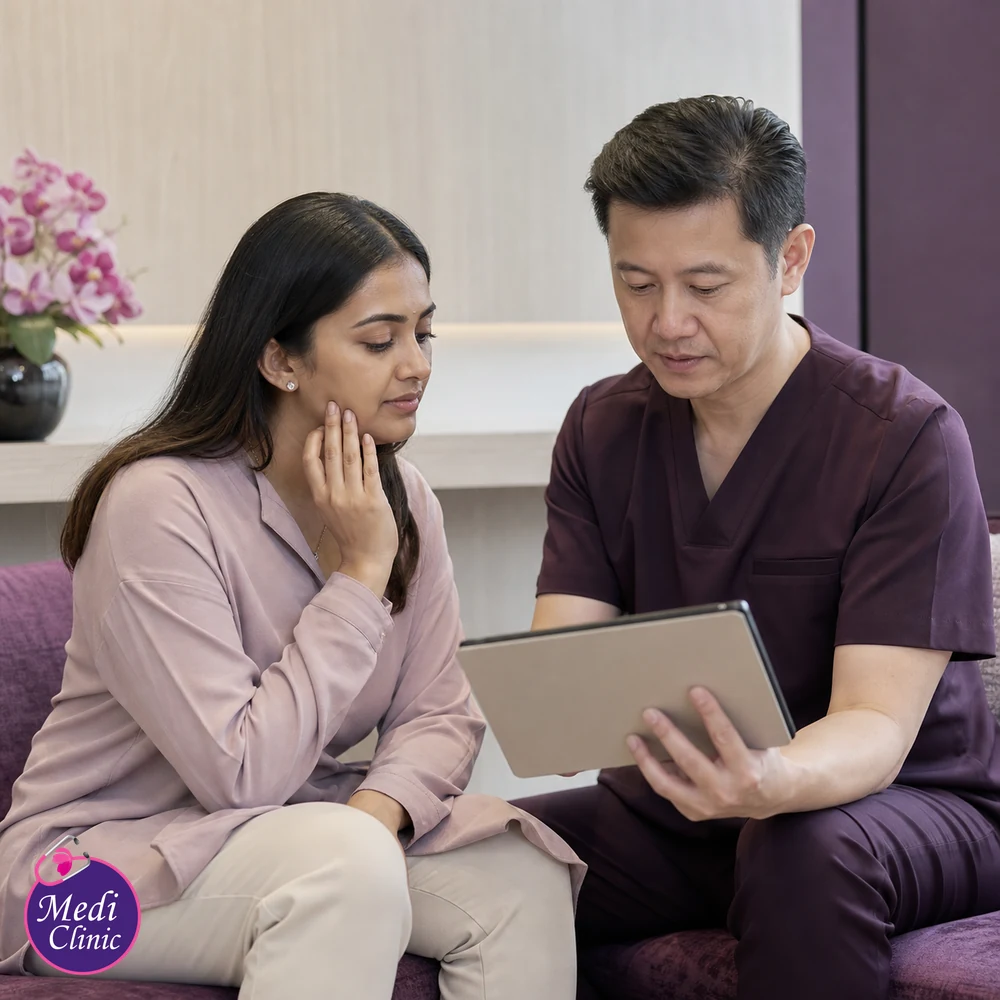
WHAT IS MAKING THE FACE LOOK HEAVIER?
Laxity can overlap with fullness and facial proportions
A lifting consultation should separate loose-looking skin from submental fullness, volume loss and chin or jaw structure. Treating the wrong contributor can create an excessive plan without addressing the feature that matters most.
Jawline proportion
When chin and jaw proportions are the main issue, use the Jawline Definition guide to compare the broader decision pathway.
Under-chin fullness
The Double Chin guide separates local fullness from skin laxity and structural factors.
Volume versus tightening
Replacing support and tightening tissue are not the same goal. One does not automatically substitute for the other, and either may be inappropriate after assessment.
VERIFIED MEDI CLINIC PATHWAYS
Verified lifting pathways use different mechanisms
These are existing Medi Clinic service pages, not a recommended package. Area, laxity degree, skin thickness, medical history, previous procedures, acceptable recovery and expected limits determine whether any option is considered.
HIFU Skin Tightening
An ultrasound-based skin-tightening category for selected patients; the assessed area and expected degree of change must be agreed first.
View service detailsULTRACEL Q+ HIFU
A device-specific HIFU pathway whose role depends on anatomy, treatment area and an individual plan rather than the device name alone.
View service detailsDENSITY RF
A radiofrequency face-treatment option that may be discussed for selected firmness and skin-quality goals after suitability review.
View service detailsThread Lift
A minimally invasive lifting pathway with different risks, recovery and limitations from energy devices; it is not a surgical facelift equivalent.
View service details
FACIAL-LIFTING ASSESSMENT
The doctor matches the mechanism to the dominant layer
The aim is to clarify what can change, what will remain and whether the expected benefit justifies treatment and recovery.
REALISTIC LIFTING JOURNEY
Non-surgical change is usually limited and maintenance may be needed
A non-surgical procedure should not be presented as equivalent to a facelift. Timing of visible change, session frequency, aftercare and side effects depend on the selected treatment and individual response. Ageing and tissue change continue, so results are not permanent.
1. Map the concern
The doctor examines the face and neck, identifies the dominant layer and records the areas that matter most to the patient.
2. Select or defer
A suitable verified option, a staged plan, another clinical route or no treatment may follow from the assessment.
3. Review before adding
Recovery and response are reviewed before repeating or adding a different mechanism; unexpected symptoms need in-person assessment.
SINGAPORE TO JOHOR BAHRU
Choose the clinic and recovery plan together
Patients travelling from Singapore should consider border route, expected recovery and whether an in-person review may be needed. Confirm availability for the selected service when booking.
Medi Clinic Taman Molek
No. 45, Jalan Molek 1/5A, Taman Molek, 81100 Johor Bahru
Daily, 10:00 am to 6:00 pm
+60 16-710 9576
Medi Clinic Eco Botanic
2C-27, Jalan Eko Botani, Persiaran Eko Botani 2, 79100 Iskandar Puteri
Daily, 10:00 am to 6:00 pm
+60 19-948 8196
Use the Singapore patient guide for border and follow-up planning.
FREQUENTLY ASKED QUESTIONS
Sagging Skin and Facial Lifting Options in Johor Bahru FAQs
What causes facial skin to look saggy?
Skin laxity, reduced tissue support, volume change, fat distribution, facial movement and bone structure can all contribute. Several factors may coexist.
Can a non-surgical treatment replace a facelift?
No. Energy devices, injectables and threads have different and generally more limited roles. More advanced laxity may require a different discussion or referral.
Is HIFU the same as radiofrequency or a thread lift?
No. These pathways use different mechanisms, have different recovery and risks, and should not be treated as interchangeable.
Can sagging and a double chin be the same concern?
They can overlap, but loose skin and submental fullness are not identical. The dominant cause should be assessed before choosing a pathway.
How many sessions will I need?
There is no responsible universal number. It depends on the selected treatment, treatment area, degree of laxity, response and review findings.
What should Singapore patients plan after a lifting procedure?
Discuss visible recovery, tenderness, border travel and whether an in-person review could be needed before fixing the treatment date.
DOCTOR ASSESSMENT BEFORE TREATMENT
Book a facial-laxity assessment before choosing a lifting treatment
Bring details of previous devices, fillers, threads or surgery and explain which face or neck change matters most. The consultation should define the dominant contributor, realistic limits and whether any verified option is suitable.


