


Understand the role of each step.
Four stages should mean four explained purposes. Ask which stages are proposed, which feature each addresses and whether the sequence has been adapted to your assessment.

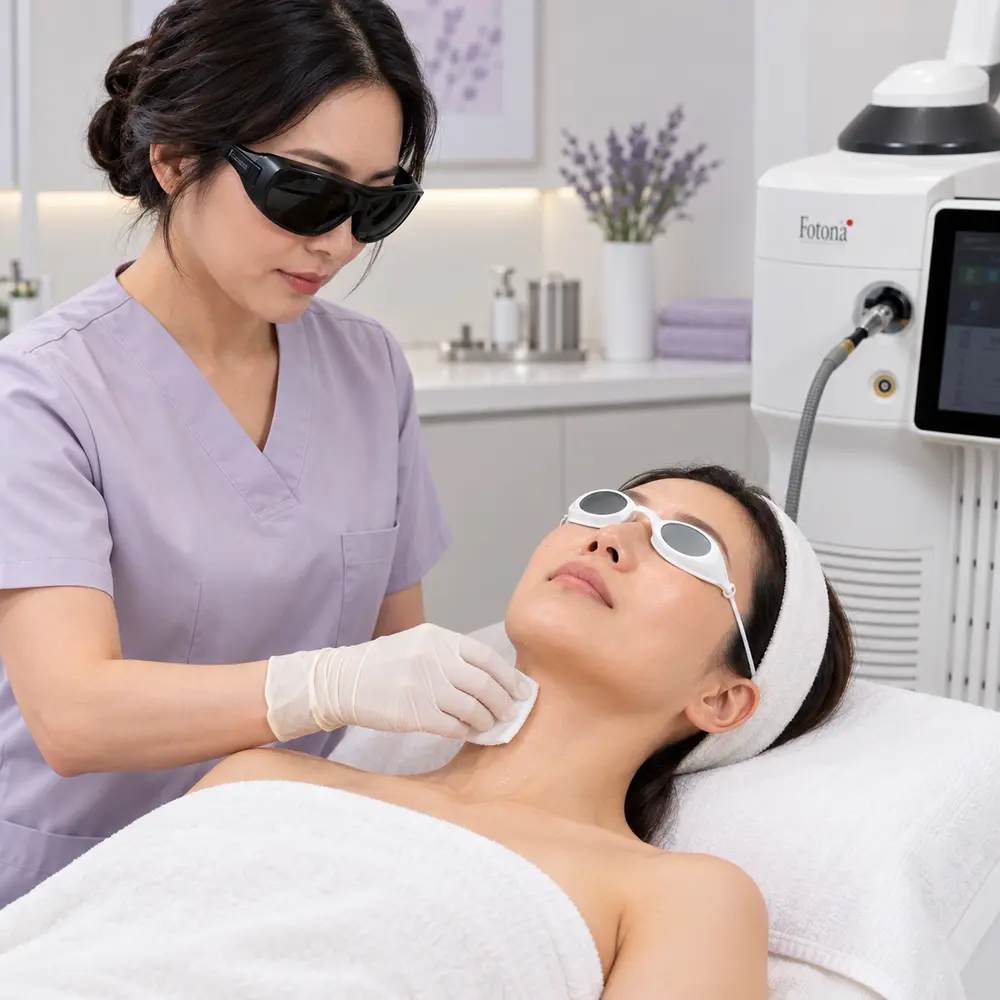
Fotona4D is a named facial laser approach using complementary Er:YAG and Nd:YAG wavelengths. The manufacturer describes treatment both inside the mouth and on the external facial skin. It is a procedure family supported by compatible Fotona platforms, not the name of a filler or an operation.
Fotona4D is a named facial laser approach using complementary Er:YAG and Nd:YAG wavelengths. The manufacturer describes treatment both inside the mouth and on the external facial skin. It is a procedure family supported by compatible Fotona platforms, not the name of a filler or an operation.
Its four modes are SMOOTH, FRAC3, PIANO and SupErficial. They combine intraoral thermal treatment, selected deeper effects, broader tissue warming and a light surface peel. These steps do different jobs; the peel means the complete sequence should not automatically be described as entirely nonablative.
A consultation can explore selected fine lines, texture changes or mild looseness. Ask whether these features are actually the main cause of the appearance you want changed. Significant tissue descent or a volume deficit may set a different limit from a surface concern.
Fotona4D uses laser light. HIFU uses focused ultrasound, a thread lift places sutures, and filler adds injectable material. A result described as volumising does not mean Fotona4D delivers a measured filler volume or reproduces a surgical lift.
Further reading: Fotona — Fotona4D treatment; Fotona — Fotona4D patient information; Fotona — Aesthetic lasers. These sources explain the treatment category or manufacturer identity; the proposed local product, device and individual plan still need confirmation.


Understanding four laser modes before deciding on a facial treatment
Agree the feature to review and what is unlikely to change.
Discuss history, anatomy, comfort and personal priorities.

Ask which compatible platform and which of the four steps are proposed. Discuss previous facial procedures, pigmentation changes after injury, recent tanning, medicines and cold-sore history. The intraoral component also makes mouth irritation and recent dental treatment worth mentioning.
Describe whether the feature that bothers you is a fold, loose-looking skin, uneven texture or a surface mark. These observations can occur together, but they do not establish that every part of a multi-step laser protocol is appropriate for you.
Bring a record of previous laser sessions, injectables, surgery and reactions to skin procedures. Tell the clinician about recent sun exposure and the products you currently use. The plan should account for your skin today, rather than copy the settings from an earlier visit.
A fold beside the nose can involve tissue position as well as skin quality.
Ask how much looseness the proposed laser plan can realistically address.
Roughness and fine surface irregularities need their own assessment.

Four stages should mean four explained purposes. Ask which stages are proposed, which feature each addresses and whether the sequence has been adapted to your assessment.
A light resurfacing stage has a different recovery discussion from a purely nonablative step. Do not rely on the treatment name alone to decide whether the surface will need special care.
A multi-step treatment is easier to assess when the goal is specific. Record the fold, texture or laxity concern you want to discuss rather than expecting every aspect of the face to change.
Switch between these matched educational views. A single selected feature changes while the identity, lighting and expression are kept consistent.
A fold beside the nose can involve tissue position as well as skin quality. Ask how much looseness the proposed laser plan can realistically address. The first view is an reference view of features to discuss, not a diagnosis.
Fotona4D cannot guarantee a facelift result, permanent tightening, a fixed increase in volume or no recovery effects.

 BeforeAfter
The divider reveals two versions of the same matched adult. Compare the feature described here rather than treating the second panel as a target face. Neither panel records a treatment at Medi.
Compare the same facial area at rest, with consistent lighting and no beauty filter. Review surface texture separately from the depth of a fold. A short-lived flushed or swollen appearance is not a reliable measure of a lasting result.
A useful real-world review needs comparable camera distance, gaze, lighting and expression. Ask what was treated, when the photographs were taken and whether other procedures or temporary swelling could explain a difference.
Ask for the exact Fotona system and the proposed protocol. A manufacturer photograph identifies a device family; it does not confirm the model available at the branch. The consultation should establish the equipment and the clinician responsible for treatment.
Discuss eye protection, the intended areas and the difference between any intraoral and external stages. A general website cannot determine a safe wavelength, energy or pass pattern for you. Those decisions belong with the treating professional and the applicable instructions.
Before booking around work or an event, ask what visible skin changes may occur with the actual sequence proposed. The recovery description should match the stages you are receiving, including any surface treatment, rather than a generic no-downtime slogan.

Skin texture and tissue position are different observations. A subtle surface change would not establish that a deep fold or substantial laxity has been corrected. Ask how the clinician will distinguish the effects being discussed at review.
Photographs should keep facial expression, camera distance and lighting comparable. A brighter image or a more upright pose can change the apparent fold and jawline without demonstrating the effect of a laser protocol.
The decision to repeat a course should follow the response, tolerability and current skin assessment. More stages or more sessions are not automatically a better plan. Ask what would lead the clinician to modify, postpone or stop the approach.
These guides answer different questions. Select an option to read its purpose, limitations and a question to bring to the consultation. A related page is not a recommendation to combine procedures.
A combination is not automatically better. Ask what each proposed procedure would contribute and whether the same goal could be approached more simply. Taking time to decide remains a useful outcome.
Select an option. See its purpose, possible benefit and the distinction that matters.
Understanding four laser modes before deciding on a facial treatmentIts four modes are SMOOTH, FRAC3, PIANO and SupErficial. They combine intraoral thermal treatment, selected deeper effects, broader tissue warming and a light surface peel. These steps do different jobs; the peel means the complete sequence should not automatically be described as entirely nonablative.
Understanding four laser modes before deciding on a facial treatment
Fotona4D cannot guarantee a facelift result, permanent tightening, a fixed increase in volume or no recovery effects.
Which part of my concern would Fotona 4D Treatment address?
 Identifying the neck concern and the actual laser method proposed
Fotona describes nonablative Er:YAG SMOOTH heating for skin laxity and Nd:YAG PIANO heating within its broader treatment range. Some plans may also involve surface resurfacing. These modes have different tissue effects and should not be bundled into an assumed neck sequence without explanation.
Identifying the neck concern and the actual laser method proposed
A Fotona neck plan cannot guarantee removal of every horizontal crease, correction of muscle bands, disappearance of a double chin or a neck-lift result.
Which part of my concern would Fotona Neck Treatment address?
 Exploring LipLase without confusing nonablative laser treatment with filler
Controlled thermal exposure is used to stimulate changes within the lip tissue over time. Manufacturer material also describes an Nd:YAG PIANO component in some LipLase descriptions. That is different from depositing a measured volume of hyaluronic-acid filler or surgically changing the lip shape.
Exploring LipLase without confusing nonablative laser treatment with filler
LipLase cannot guarantee filler-equivalent volume, a chosen syringe-sized increase, permanent enlargement or correction of every asymmetry and perioral line.
Which part of my concern would Fotona Lip Treatment address?
 A device-specific approach to focused ultrasound and selected skin laxity
Focused ultrasound can produce localised thermal effects while energy passes through the overlying surface. The intended target depends on the device and transducer. Selecting that target requires anatomy assessment; a stated cartridge depth does not mean every face has the same tissue arrangement.
A device-specific approach to focused ultrasound and selected skin laxity
HIFU cannot guarantee a surgical lift, suit every tissue thickness, remove all excess skin or safely treat every area around the eyes and neck.
Which part of my concern would HIFU Skin Tightening Treatment address?
Use these five points to compare a consultation at Eco Botanic with any other clinic you are considering.
| What matters | Ask Medi Clinic Eco Botanic | Check with any clinic |
|---|---|---|
| 01Practitioner | Ask our team for the treating doctor’s name and credentials. | Check the named doctor’s current registration and relevant LCP scope. |
| 02Individual assessment | Discuss your skin, facial anatomy, history and priorities. | Look for an explanation of suitability, alternatives and what will remain unchanged. |
| 03Product & treatment plan | Confirm the proposed product, treatment scope and traceability. | Compare the actual brand and plan, not a generic treatment label. |
| 04Price & consent | Request an itemised explanation before deciding. | Check what the quote includes, possible risks and whether there is time for questions. |
| 05Review & continuity | Discuss review arrangements, including after returning to Singapore. | Confirm who handles concerns, how to contact them and any review costs. |
Bring your questions, previous treatment details and relevant medical history. Tell the clinic if your return journey has a fixed time.
Discuss the proposed method, intended change, alternatives, consent and full cost before deciding whether to proceed.
Follow the treating clinician’s advice. Keep the treatment record and clinic contact accessible while travelling.
Use the agreed review arrangements. Report unexpected symptoms promptly rather than waiting for another trip to Malaysia.

Recovery should reflect the actual laser modes used, especially any surface peeling. Ask about redness, swelling, sensitivity, burns, pigment changes and infection, together with the required eye protection. Blistering, increasing pain or a new eye symptom calls for clinical assessment.
Before a visit from Singapore, clarify whether the appointment is for assessment or a full sequence. Bring an unfiltered reference photograph and plan sun exposure, skincare and follow-up around the written instructions for your treatment.
For Fotona 4D Treatment enquiries in the Johor Bahru area, confirm the Eco Botanic branch in Iskandar Puteri. It is a different location from Taman Molek. Ask for the appointment time and map location together so the travel plan matches the booking.
Allow flexibility for border conditions and a proper consultation. This guide does not promise a fixed journey time. If you need to return to Singapore by a particular time, explain that before the appointment. An assessment may lead to further advice or a decision to postpone treatment.
Discuss follow-up before crossing the border. Ask when progress should be reviewed, whether a return visit may be needed and how to contact the treating team. A message can help explain a concern, but it cannot replace an examination when one is needed.
Request an itemised quote in the currency being used, including what consultation and review arrangements cover. Keep the clinic contact and written instructions with you. If an urgent problem occurs after returning to Singapore, seek care where you are rather than delaying care for travel.

Confirm the branch, appointment, care plan and review arrangements with our team.
A fold beside the nose can involve tissue position as well as skin quality.
Ask how much looseness the proposed laser plan can realistically address.
Roughness and fine surface irregularities need their own assessment.
Separate lines visible at rest from those appearing mainly with expression.
Select the concern you want to explore. Read its description here, then find related services at the end of this guide.
A fold beside the nose can involve tissue position as well as skin quality.
Five questions to help you understand Fotona 4D Treatment before your consultation.


It is a named treatment approach. Compatible Fotona systems can deliver it, so ask for the actual platform and proposed steps.
No. The sequence includes different thermal modes and a light peel. Their targets and recovery implications are not identical.
The manufacturer describes intraoral thermal stimulation as one component of the facial sequence. The clinician should explain its purpose in your plan.
It does not place filler material. Whether a collagen-remodelling approach meets your goal depends on the assessed concern and desired scale of change.
Complete removal should not be promised. The examination should separate skin quality from anatomy and tissue descent.
No such guarantee follows from the name. Ask whether a surface peel is included and what recovery to expect from that step.
Yes. The proposed intraoral treatment makes those details relevant to the consultation.
Return to the original feature under consistent conditions. Review texture, fine lines and fold contour separately rather than judging an overall glow.
Read the purpose, suitability questions and limitations before choosing a procedure.
View details
Read the purpose, suitability questions and limitations before choosing a procedure.
View details
Read the purpose, suitability questions and limitations before choosing a procedure.
View details
Read the purpose, suitability questions and limitations before choosing a procedure.
View detailsDiscuss Fotona 4D Treatment in Johor Bahru (JB), your priorities and follow-up arrangements with our team before planning your visit.
Book via WhatsAppAn enquiry starts the conversation. Your appointment is confirmed by the clinic.
Daily 10:00–18:00 · By appointment
2C-27, Jalan Eko Botani, Persiaran Eko Botani 2, 79100 Iskandar Puteri, Johor, Malaysia.
Open directions in Google Maps ↗